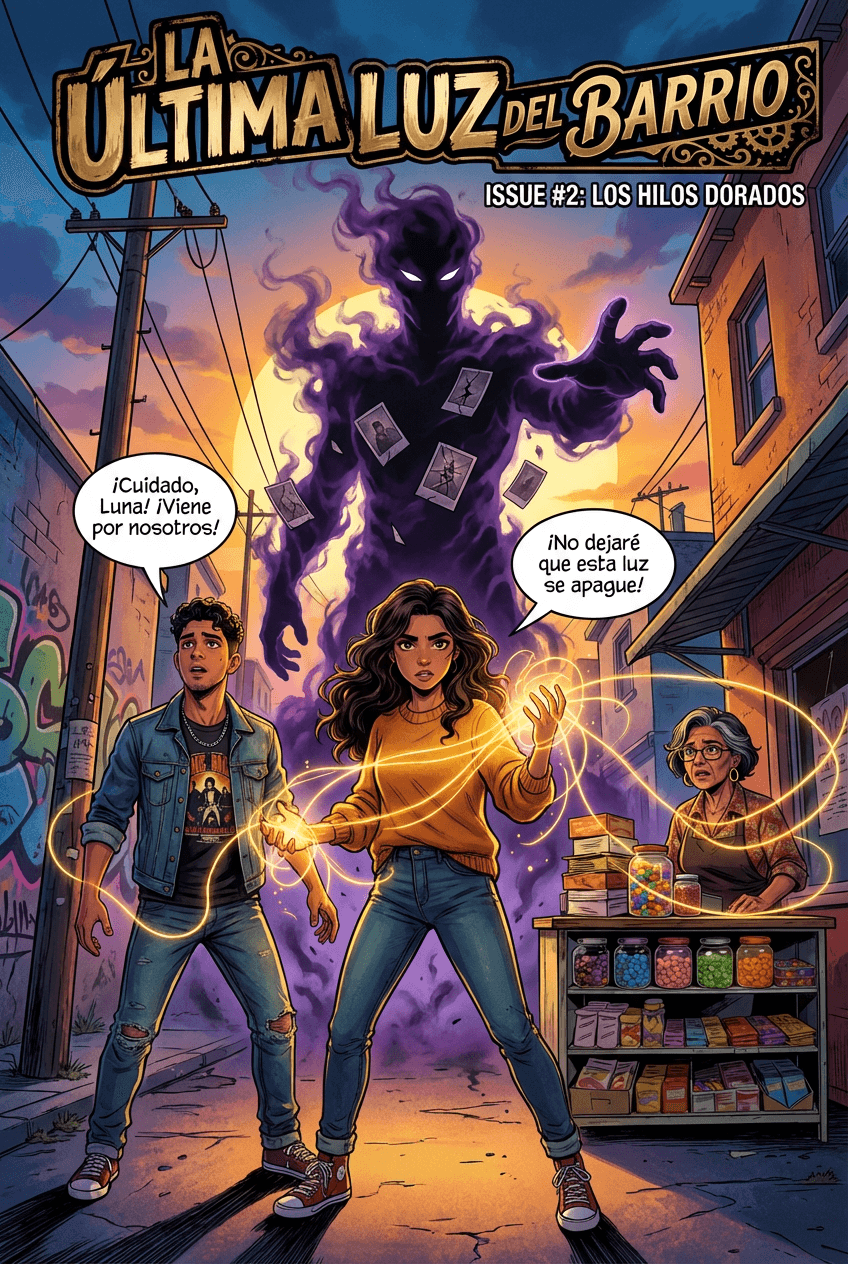
Cuando la Luz Se Apaga
In a vibrant Latino neighborhood in a large city, a 19-year-old woman discovers she has inherited a mysterious ability from her abuela: she can see and protect the “luz” (spirit/light) inside people. But the neighborhood is changing — gentrification, disappearing family businesses, cultural erosion. And something darker feeds off forgotten memories and broken community bonds. Her power may be the only thing that can save the barrio.
The story takes place in a vibrant Latino neighborhood that is slowly changing due to gentrification. Murals are fading, small family businesses are closing, and longtime residents are leaving. The main character is @Luna Morales , a 19-year-old Latina woman who works at her family’s panadería and dreams of becoming an illustrator. She is close to her grandmother, @Abuela Rosa , who is wise, warm, and deeply connected to the community. The issue opens with a warm family gathering at the panadería, filled with laughter, music, and cultural richness. @Abuela Rosa shares a proverb about memory being the soul of a community. Soon after, @Abuela Rosa passes away peacefully. The tone shifts to quiet grief. During the funeral, @Luna Morales begins seeing faint golden threads of light connecting people in the neighborhood. She thinks she is imagining it. Over the next few days, @Luna Morales notices strange changes: a colorful mural begins to lose its color, an elderly shop owner, @Doña Carmen, forgets why he opened his store, and parts of the neighborhood appear drained of warmth. One night, @Luna Morales encounters a shadowy, smoke-like entity in the street — @El Olvido . It moves silently and causes nearby lights and colors to fade. It is not fully solid, more like drifting darkness with faint glowing eyes. When @Luna Morales comforts the @Doña Carmen and encourages him to tell the story of how he started his business, the golden threads brighten and the mural regains some of its color. @Luna Morales realizes she has inherited her grandmother’s gift: the ability to see and protect the “luz” inside people through memory and storytelling. The issue ends with @Luna Morales standing in the street at sunset, golden threads glowing around her hands, while @El Olvido watches from a rooftop in the distance — stronger than before, but no longer unnoticed.
CHARACTERS
Mateo
supporting
Doña Carmen
supporting
Luna Morales
protagonist
El Olvido
antagonist
Abuela Rosa
supporting
Ricardo
supporting
PAGE 1
Panel 1:Wide shot of the Morales Panadería, bustling with activity. Sunlight streams in through the windows, illuminating dust motes dancing in the air. The aroma of freshly baked bread fills the scene. Luna Morales sits at a small table near the window, sketching in her notebook.
“¡Mira, Luna! ¡Otra vez dibujando! Nunca paras, ¿verdad?”
Panel 2:Close-up on Luna Morales' notebook. We see her sketch: a vibrant depiction of her family working in the panadería, but also subtle details like peeling paint on the walls.
Panel 3:Medium shot of Abuela Rosa, her face beaming, surrounded by family. She holds a freshly baked pan dulce.
“¡Este pan dulce es para celebrar! ¡Otro mes exitoso gracias a todos ustedes!”
Panel 4:Close-up on Abuela Rosa's face, her eyes twinkling with wisdom and warmth.
“Recuerden, familia, un pueblo sin memoria es un pueblo sin alma.”
PAGE 2
Panel 1:Medium shot of Luna Morales looking at Abuela Rosa with affection.
“Siempre tan sabia, Abuela.”
Panel 2:Panel showing Doña Carmen entering the Panaderia. She's carrying a small bouquet of flowers.
“Rosa, mi querida, ¡mira qué bonitas flores te traje!”
Panel 3:Close-up of Abuela Rosa accepting the flowers, her smile genuine.
“¡Ay, Carmen, qué linda! Siempre tan atenta. ¡Muchas gracias!”
Panel 4:Wide shot of the family gathered, laughing and talking. The atmosphere is warm and inviting.
PAGE 3
Panel 1:Close-up on Luna Morales' face as she observes her family, a thoughtful expression on her face.
Panel 2:Medium shot of Abuela Rosa, now sitting in a comfortable armchair, looking tired but content.
“Estoy un poco cansada. Creo que voy a descansar un rato.”
Panel 3:Luna Morales helps Abuela Rosa to her room.
“Yo te acompaño, Abuela.”
Panel 4:A quiet, peaceful image of Abuela Rosa sleeping in her bed, a faint smile on her face. Soft sunlight streams through the window.
PAGE 4
Panel 1:Close-up on Luna Morales' face, her eyes wide with shock and grief. She is kneeling beside Abuela Rosa's bed.
“¡Abuela! ¡Abuela, despierta!”
Panel 2:Medium shot of the Morales family gathered in the living room, their faces etched with sorrow. They are embracing each other, crying softly.
Panel 3:Wide shot of the funeral procession winding through the neighborhood streets. Many residents are in attendance, their heads bowed in respect.
Panel 4:Close-up on Luna Morales' face, her eyes red and swollen with tears. She is looking at the crowd of mourners.
PAGE 5
Panel 1:Luna Morales stands near the open casket, looking down at Abuela Rosa's peaceful face. She is holding a single white rose.
“Te quiero mucho, Abuela.”
Panel 2:As Luna Morales steps back, she sees faint golden threads connecting people in the crowd, especially those who were close to Abuela Rosa. She blinks, thinking she is imagining it.
Panel 3:Close-up on the golden threads, shimmering faintly in the air. They seem to pulse with a gentle light.
Panel 4:Luna Morales rubs her eyes, dismissing the vision as grief-induced hallucination.
“Debo estar cansada...”
PAGE 6
Panel 1:Wide shot of the cemetery, the sky overcast. The mourners are gathered around Abuela Rosa's grave, listening to the priest's words.
Panel 2:Close-up on Luna Morales' face, her expression a mixture of sorrow and determination. She is holding back tears.
Panel 3:Medium shot of Doña Carmen placing flowers on Abuela Rosa's grave, her face etched with sadness.
“Descansa en paz, mi amiga.”
Panel 4:The scene fades to black, leaving only the image of a single flickering candle.
PAGE 7
Panel 1:Luna Morales stands behind the counter at the panadería, looking tired and withdrawn. The panadería is less bustling than before.
Panel 2:Luna Morales looks out the window at the vibrant mural on the side of a building across the street. The mural depicts scenes from the neighborhood's history.
Panel 3:Close-up on the mural. The colors are noticeably faded, lacking their previous vibrancy.
Panel 4:Doña Carmen is standing outside his botanica across the street, looking confused and disoriented.
“¿Qué estaba haciendo...?”
PAGE 8
Panel 1:Luna Morales walks across the street to Doña Carmen, concern etched on her face.
“Doña Carmen, ¿está bien? ¿Necesita ayuda?”
Panel 2:Close-up on Doña Carmen's face, his eyes clouded with confusion and frustration.
“No... no recuerdo... ¿Por qué abrí la tienda hoy?”
Panel 3:Luna Morales takes Doña Carmen's hand, offering him a reassuring smile.
“Tranquilo, Doña Carmen. Tal vez sólo está cansado. ¿Por qué no entra y descansa un poco?”
Panel 4:Luna Morales looks back at the faded mural, a growing sense of unease washing over her.
PAGE 9
Panel 1:Luna Morales sits inside the panadería, sketching the mural in her notebook. The colors in her sketch seem dull and lifeless.
Panel 2:Close-up on Luna Morales' sketch. The vibrant scenes from the mural are rendered in muted, desaturated colors.
Panel 3:Luna Morales sighs, frustrated by her inability to capture the mural's original beauty.
“No puedo... no se ve igual.”
Panel 4:Luna Morales stares out the window, her eyes fixed on Doña Carmen's botanica. The plants inside look wilted and lifeless.
PAGE 10
Panel 1:Luna Morales sits with Doña Carmen inside his botanica. Doña Carmen looks vacant and confused.
“Doña Carmen, ¿se acuerda de por qué abrió esta botánica?”
Panel 2:Close up on Doña Carmen's face. He is struggling to remember. Sweat beads on his forehead.
“Yo... no... no lo sé. No me acuerdo...”
Panel 3:Luna Morales notices that the golden threads around Doña Carmen are faint and barely visible. The plants around them seem even more wilted.
Panel 4:Luna Morales takes Doña Carmen's hands again, her expression filled with determination.
“No se preocupe, Doña Carmen. Lo vamos a recordar juntos.”
PAGE 11
Panel 1:Close-up on Luna Morales' hands holding an old, faded photograph. The photo shows a younger Doña Carmen standing proudly in front of his newly opened botanica, surrounded by lush plants.
Panel 2:Medium shot of Doña Carmen looking intently at the photograph, his brow furrowed in concentration. A flicker of recognition crosses his face.
“¿Yo... ese soy yo? ¿Cuándo fue tomada esta foto?”
Panel 3:Close-up on Luna Morales' face, her expression hopeful and encouraging.
“Hace mucho tiempo, Doña Carmen. Cuando abrió la botánica. ¿Se acuerda de por qué la abrió?”
Panel 4:Medium shot of Doña Carmen, his eyes widening slightly. He points to a specific plant in the photo – a small aloe vera.
“La sábila... mi abuela me enseñó sobre la sábila. Dijo que curaba todo...”
Panel 5:Luna smiles warmly. The golden threads around Doña Carmen shimmer brighter.
“¡Eso es! Siga recordando, Doña Carmen.”
PAGE 12
Panel 1:Wide shot of the botanica. The plants inside seem to be regaining some of their vitality. A small section of the faded mural outside, depicting aloe vera plants, has regained its color.
Panel 2:Close-up on the vibrant section of the mural, the colors rich and alive.
Panel 3:Luna Morales is sketching. She looks more inspired, colors more vibrant.
Panel 4:On a distant rooftop, we see El Olvido, as a darker mass in the background.
PAGE 13
Panel 1:Wide shot of the neighborhood at night. A few streetlights flicker weakly. Luna Morales is walking home, looking thoughtful.
Panel 2:El Olvido manifests in a dark alleyway ahead of Luna Morales. It's more defined than before, the shadowy form clearer.
Panel 3:Close-up on Luna Morales' face, her eyes widening in fear and recognition.
“Tú...”
Panel 4:The streetlights behind Luna Morales flicker and die, plunging the street into darkness.
PAGE 14
Panel 1:Luna Morales stands frozen in place, staring at El Olvido. The shadowy entity seems to grow larger, the air around it shimmering with cold.
Panel 2:Close-up on El Olvido's shadowy form. Faint, glowing red eyes are visible within the darkness.
Panel 3:Luna Morales clenches her fists, a determined expression on her face despite her fear.
“¿Qué quieres?”
Panel 4:El Olvido doesn't speak, but a wave of cold air emanates from it, causing Luna Morales to shiver.
PAGE 15
Panel 1:Wide shot of the street. El Olvido begins to dissipate, fading back into the shadows of the alleyway.
Panel 2:Close-up on Luna Morales' face, her expression a mixture of fear, anger, and determination.
“No te tengo miedo.”
Panel 3:The faded mural on the building across the street appears even more washed out, almost completely devoid of color.
Panel 4:Luna Morales looks at the mural, then at her hands. She sees the faint golden threads glowing faintly around her fingers.
PAGE 16
Panel 1:Luna Morales is back in Doña Carmen's botanica, helping him water the plants. Doña Carmen is telling a story, his face animated.
“Y entonces, mi padre me dijo, 'Carmen, esta botánica es más que un negocio, es un legado.'”
Panel 2:Close-up on Luna Morales' face, listening intently, her eyes filled with compassion.
Panel 3:The plants in the botanica look healthier, their leaves vibrant and green.
Panel 4:The golden threads around Doña Carmen are now clearly visible, radiating a warm, golden light.
PAGE 17
Panel 1:Luna Morales and Doña Carmen are laughing together, sharing a moment of genuine connection.
“¡Ay, Doña Carmen, me hace reír!”
Panel 2:Close-up on Luna Morales' hands. The golden threads are glowing brightly, almost pulsing with energy.
Panel 3:Luna looks at the mural outside the window. More colors have returned, especially around the images of plants and people.
Panel 4:Doña Carmen looks at the mural, a look of peace and understanding on his face.
“Está volviendo... la luz está volviendo.”
PAGE 18
Panel 1:Luna Morales is standing alone in the botanica, looking at her hands, her expression thoughtful.
“Abuela... esto es lo que tú hacías, ¿verdad?”
Panel 2:Close-up on her face, her eyes filled with a newfound understanding and determination.
“Proteger la luz... la memoria de mi barrio.”
Panel 3:Luna Morales walks out of the botanica and stands on the sidewalk, looking around at the neighborhood.
Panel 4:The golden threads around Luna Morales are now brightly visible, extending outwards and connecting her to the buildings and people around her.
PAGE 19
Panel 1:Wide shot of the neighborhood street at dusk. The sky is a vibrant mix of orange, purple, and pink. Luna Morales stands tall, a beacon of light in the fading day.
Panel 2:Close-up on Luna Morales' face, her expression resolute and determined. The golden threads around her hands glow with a fierce intensity.
“No voy a dejar que te lo lleves.”
Panel 3:On a distant rooftop, El Olvido watches Luna. It is now more solid, its form more defined, its eyes burning with a malevolent red glow.
Panel 4:Close up on El Olvido's face. A sinister smile can almost be seen within the shadows. It is getting stronger.
PAGE 20
Panel 1:Medium shot of Luna Morales looking towards the sky, her expression unwavering. The golden threads around her pulse with energy.
“Este barrio no se va a olvidar.”
Panel 2:A section of the mural behind her now has nearly all its color restored, looking as vibrant as it did when it was first painted.
Panel 3:Extreme close-up on Luna Morales' eyes, reflecting the golden light of her power. Her eyes are filled with determination and hope.
Panel 4:El Olvido disappears in a puff of dark smoke.
PAGE 21
Panel 1:Wide shot of the barrio at night. Many windows are now lit with warm, golden light. People are visible in some of the windows, talking and laughing.
Panel 2:Close-up on Luna Morales' face, her expression determined and hopeful. The golden threads around her hands shine brightly, and now extend further, connecting her to more buildings and people.
“¡No te vas a llevar mi barrio!”
Panel 3:El Olvido reappears in the middle of the street, now almost completely solid, a towering figure of darkness. Its red eyes burn fiercely. It is much larger than before.
Panel 4:Close-up on El Olvido's face. A raspy, echoing voice seems to emanate from the shadows.
“Crees que puedes detenerme, niña? La memoria es frágil. El olvido... inevitable.”
Panel 5:Luna Morales stands her ground, her golden threads glowing even brighter. Behind her, in some windows, people hold up candles, their faces illuminated by the warm light.
“¡No si luchamos juntos!”
PAGE 22
Panel 1:Medium shot of several residents of the barrio standing in their doorways and on balconies. They are holding candles and looking towards El Olvido with defiance.
“¡Este es nuestro barrio! ¡No te lo vamos a dar!”
Panel 2:Luna Morales focuses her energy, the golden threads around her hands now forming a protective shield around the neighborhood.
“¡La luz de mi gente nunca se apagará!”
Panel 3:El Olvido recoils from the combined light and energy. Its form flickers and weakens.
“¡Imposible! ¡Volveré! El olvido siempre regresa...”
Panel 4:El Olvido dissipates into a cloud of dark smoke, vanishing into the shadows of the alleyways.
Panel 5:Wide shot of the barrio at dawn. The mural is now completely restored, vibrant and full of life. The golden threads still connect Luna Morales to the neighborhood, but they are now a symbol of hope and resilience.
Panel 6:Close-up on Luna Morales' face, her expression filled with hope and determination. She smiles, knowing her journey has just begun.
“Abuela... te prometo que cuidaré nuestro barrio.”