How to Make a Graphic Novel: A Step-by-Step Guide
How to make a graphic novel from idea to finished pages: premise, script, characters, page layouts and pacing, with 12 graphic novel ideas and a free printable template.
To make a graphic novel, start with a premise you can state in one sentence, outline it into acts, write a page-by-page script, design your main characters, then lay out and draw the pages, usually 60 to 200 of them. The writing and the planning take longer than people expect; most of the work is deciding what goes on each page before anything is drawn. You can draw it yourself, work with an artist, or generate the pages with an AI tool from your script.
This guide walks through each stage in order, with the decisions that matter at each one. If you have never written comics before, read it start to finish. If you already have a script, skip to the section on pages.
What makes a graphic novel different from a comic book
A graphic novel is a complete, book-length story told in comics form. The Wikipedia definition is deliberately loose, because the term covers everything from memoir to superhero collections, but in practice two things separate a graphic novel from a single comic book issue.
Length. A monthly comic issue runs about 20 to 32 pages. A graphic novel is usually 60 pages or more, and many run past 200. That length changes how you plan: you cannot hold the whole thing in your head, so you need an outline before you need a script.
Shape. A comic issue is one chapter of something ongoing. A graphic novel has a beginning, middle and end inside one book. Art Spiegelman's Maus and Marjane Satrapi's Persepolis both read like novels: chapters, a full character arc, an ending that closes the story rather than setting up the next issue.
If your story fits in 24 pages, you are making a comic book, and our guide to making a comic book is the better place to start.
Step 1: Find a premise that can carry 100 pages
A good graphic novel premise has a character who wants something, a reason they cannot easily get it, and a world that looks interesting on the page. That last part is specific to comics. A story set entirely in a beige office will be hard to draw for 150 pages; the same story set on a night ferry or in a flooded city gives every page something to look at.
Write the premise as one sentence: who wants what, and what is in the way. If you cannot, the idea is not ready yet.
12 graphic novel ideas to start from
These are deliberately specific, because specific ideas are easier to develop than broad ones:
- A night-shift nurse discovers she can pause time for exactly ten seconds, and only when someone is about to die.
- An old ramen cook teaches his recipe to a runaway, one bowl a night, before his shop is demolished.
- Two sisters inherit a lighthouse and find their late mother's logbook describes ships that never existed.
- A climbing guide has to bring an injured stranger down a mountain through a storm, and he is not telling her the truth about why he was up there.
- A small-town postal worker starts receiving letters addressed to people who have not been born yet.
- A retired superhero runs a bakery and is asked, very politely, to come back for one last job.
- A translator at a peace summit realizes one side's messages are being changed in transit.
- A girl raised on a generation ship sees a real sky for the first time and hates it.
- A jazz musician's stolen trumpet turns up in a pawnshop with someone else's name engraved on it.
- A botanist shrinks to the size of an ant and has to cross her own garden to get home.
- A detective in 1940s Los Angeles is hired to find a man who, according to every record, never existed.
- A family's annual road trip is told from the point of view of the car.
If you want quicker gag-sized ideas instead, the comic strip ideas post has sixty.
Step 2: Outline before you script
For a book-length story, outline in three layers:
- Acts. Three or four acts, a paragraph each. What changes in each one?
- Chapters. Ten to twenty chapters, a few sentences each. Each chapter should end on a change: a decision, a reveal or a loss.
- Page counts. Give each chapter a rough page budget. This is the step most first-time writers skip, and it is the reason so many graphic novels have a rushed final act. If the climax only gets eight pages, it will read like a summary.
Will Eisner, whose A Contract with God helped popularise the term "graphic novel" in 1978, also wrote the standard textbook on how comics tell stories, Comics and Sequential Art. The practical lesson for outlining is to plan the story as a sequence of moments the reader will see, not a list of events that happen. Two characters arguing for a page is one moment; a car chase across a city might be six.
Step 3: Write the script
A graphic novel script uses the same format as a comic book script, just more of it: numbered pages, numbered panels, a description of what each panel shows, and the dialogue, captions and sound effects that go in it. If you have not written one before, our comic script format guide covers the exact layout, and how to write a comic book script covers the craft.
Three habits matter more at book length than in a single issue:
- Keep a character sheet open. Names, ages, what each person wears, how they talk. Across 150 pages, small drift (a scar that moves, a jacket that changes colour) becomes very visible.
- Write one chapter at a time, then reread the outline. Book-length stories wander. Checking the outline after every chapter keeps the middle from sagging.
- Mark the big pages. Note in the script which pages are reveals, arrivals or turning points. Those get bigger panels and more space, and you should know where they are before layout begins.
Step 4: Design your characters
Readers recognise comic characters by silhouette and colour before they read a face. Give each main character one strong visual element: a coat, a hairstyle, a colour palette. Draw (or generate) a reference sheet with a front view, a side view and a few expressions. The free character sheet template is laid out for exactly this.
Character consistency is the hardest part of a long comic, whether you draw by hand or use AI. It is also the main reason we built ComicInk the way we did: you define each character once, with reference images, and those references are attached to every page the AI draws, so the same face appears on page 1 and page 140.
Step 5: Lay out the pages
Page layout is where a script becomes a comic. Most graphic novel pages have between three and seven panels. Fewer, wider panels slow the reader down; more, smaller panels speed them up. The comic panel layouts guide goes through the common layouts and when to use each.
Here is the opening page of Above the Clouds, a mountain-rescue story made with ComicInk in the Realistic style:
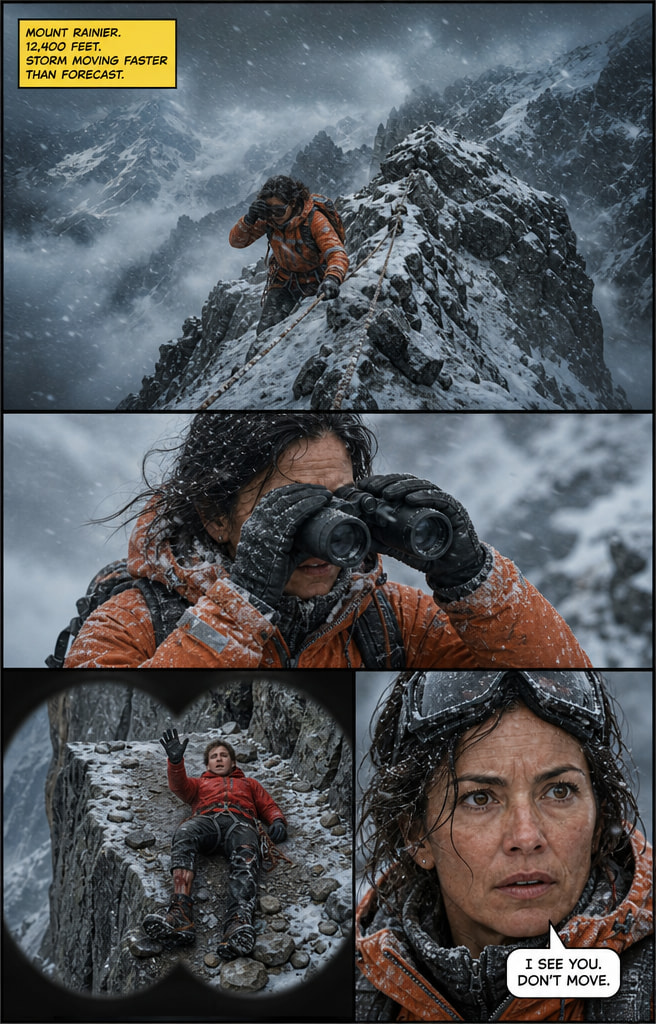
Notice what the layout is doing. The first panel is wide, to establish where we are and how dangerous it is. The second narrows in on the character. The third is a point-of-view panel shaped like the binoculars, so we see what she sees. The last is a close-up for the emotional beat and the only line of dialogue. Four panels, and the reader knows the setting, the character, the problem and the stakes. That is what a first page has to do.
In ComicInk there is no layout setting to pick; the shape of a page comes from how many panels the script gives it and how each one is described. A panel described as a "wide establishing shot" comes out wide. That means you lay out pages by writing them, which suits a book-length project well.
Step 6: Make the pages
You have three ways to turn a script into finished pages:
- Draw it yourself. The slowest route and the most personal. Print the graphic novel template, pencil the layouts, then ink. Budget a day or more per page.
- Work with an artist. Professional comic art is usually priced per page, and a book-length project is a serious commitment for both of you. A finished script and character sheets make that collaboration much easier.
- Generate the pages with AI. Paste or write your script into a tool like ComicInk, set up your characters with reference images, choose one of 12 art styles, and generate pages. A page costs 50 credits, and you can regenerate a single panel without redoing the whole page.
In ComicInk, an issue can run from 4 to 36 pages, so a graphic novel is made as a series of issues, one per chapter or act, linked into a story arc so the AI carries who's who and what just happened from one issue into the next. New accounts start with 100 free credits and no card, and your first two page renders are free, so you can see your characters on a finished page before spending anything.
Step 7: Letter, review and publish
Lettering (the dialogue balloons, captions and sound effects) is the last pass and the one most likely to be rushed. Read every page aloud. Cut long balloons; if a balloon covers a face, the line is too long or in the wrong place.
Then read the whole book in one sitting. Pacing problems that are invisible page by page become obvious at full length: a chapter that drags, a reveal that comes too early, a character who disappears for forty pages.
When it is ready, you can self-publish your comic online, print it, or publish it inside ComicInk for free, or sell it in your own store and keep 70% of each sale.
A realistic timeline
For a first graphic novel of around 100 pages, plan on:
- Premise and outline: one to two weeks.
- Script: four to eight weeks, at a few pages a day.
- Character design: a few days.
- Pages: months if you are drawing by hand; days to a few weeks if you are generating them from a finished script and revising as you go.
- Lettering and revision: two to four weeks.
The writing is the part no tool can shortcut. A clear outline and a finished script make every later step faster, however the pages get made.
Download the free template
A printable PDF companion to this guide — use it for your next script.
Download the free graphic novel template (PDF)Ready to make your own comic?
A free account and 100 credits get you started. No drawing skills, no credit card.
Start your comicMore from the blog
How to Make a Comic Book in 2026: A Step-by-Step Guide
From idea to finished pages: free tools, AI generators, script templates, character workflow, and the publishing routes that actually work.
How to Write a Comic Script: The Complete Guide
Everything that goes into a comic script — format, structure, panel descriptions, dialogue, pacing and a full worked example — with a free downloadable template.
Comic Panel Layouts: 7 Page Layouts and When to Use Each
The main comic panel layouts explained: grid, six- and nine-panel pages, widescreen tiers, splash pages, inset panels, manga reading order and webtoon vertical scroll, with real example pages.