50 Comic Book Ideas: Story Premises by Genre (With What Makes Each Work)
Original comic book ideas for one-shots, series and graphic novels, sorted by genre: superhero, fantasy, sci-fi, horror, mystery, romance, slice of life, kids, historical and manga, with the visual hook behind each.
A good comic book idea is a one-line premise with something to see: a strange power, a place that looks like nowhere else, or a reveal you can save for a full page. Below are 50 original story ideas for multi-page comics, sorted by genre, each with a hook and a note on why it works on the page. Pick one, write the ending first, and you have the start of a one-shot, a series or a graphic novel.
If you want quick four-panel gags instead of longer stories, our list of 60 comic strip ideas is the better place to start.
What makes a comic book idea work
A premise that works as a short story does not always work as a comic. Comics are a visual medium read one page at a time, so the best ideas share three things:
- A visual hook. Something the reader has never seen drawn before: a city on the back of a whale, a power that turns rain into glass. If the idea could be told entirely in dialogue, it may be a better radio play.
- A page-turn reveal. The right-hand page is where you set up a question; the next left-hand page is where you answer it. Ideas with a built-in twist use that rhythm naturally.
- A small, distinct cast. Two to four characters you can tell apart at a glance. Readers recognise faces before they read names.
It also helps to state the idea as a logline, a single sentence that says who wants what and what stands in the way. Screenwriters use loglines to test whether a story has a spine before writing a page, and the same test works for comics. Every idea below is written that way.
Superhero comic book ideas
The superhero ideas that last are usually about the person, not the power. Give the power a cost and put the hero somewhere ordinary.
- The ten-second nurse. An ER nurse can stop time for ten seconds, and each use leaves her shaking. Works because: every freeze is a splash moment, and the cost forces hard choices.
- Hero, part-time. A teenager inherits a cape that only works during her shift at the corner shop. Works because: the shop is a recurring set, and the rules create comedy.
- The retired sidekick. A former sidekick, now a dentist, gets a call that the hero he quit on has gone missing. Works because: flashback pages in a brighter style contrast with the present.
- Weather debt. A girl who can stop storms learns that every one she stops arrives somewhere else, twice as strong. Works because: the map of where the storms land becomes a visual clock.
- The villain's accountant. A mild bookkeeper realises the supervillain he works for is about to go bankrupt, and so is the city. Works because: deadpan office panels next to explosions.
Fantasy comic book ideas
Fantasy earns its pages with places. Build one location you can return to and make it look like nowhere else.
- The library that eats lies. An apprentice librarian must catalogue a book that rewrites itself every time someone lies nearby.
- Second-hand dragon. A family buys an elderly dragon from a closing circus and discovers it remembers a war nobody else does.
- The lighthouse at the end of the map. A keeper's job is to keep ships from sailing past the last line of the world.
- Borrowed shadows. In a town where shadows can be rented, a girl's shadow refuses to come back.
- The cartographer's apprentice. Every map she draws becomes true by morning, including her mistakes.
Sci-fi comic book ideas
Sci-fi ideas work best with one big change and its everyday consequences.
- The last analogue clock. On a generation ship, a kid finds a wristwatch that disagrees with the ship's computer about how long the trip has lasted.
- Memory postage. You can mail a memory to anyone, and someone keeps sending you ones you don't remember having.
- Planet with one road. Two drivers on opposite ends of a planet-wide highway realise they're the only two people left.
- The repair bot who wanted to be broken. A maintenance robot sabotages itself to keep meeting the engineer who fixes it.
- Daylight shift. On a moon where day lasts six months, a courier must cross the dark side before the sun catches up.
Horror comic book ideas
Horror on the page is about what you hide in the gutter between panels. Scott McCloud's Understanding Comics calls that gap "closure": the reader fills in what happens between two panels, and in horror their imagination is always worse than your drawing.
- The extra step. A family's staircase has thirteen steps at night and twelve in the morning.
- Group photo. Every photo taken at a summer camp shows one more child than attended.
- The quiet street. A neighbourhood where everyone stops talking the moment a new family moves in.
- Night-shift janitor. A cleaner at a closed museum keeps finding the exhibits rearranged into a message.
- Don't let it rain inside. A house where weather follows the residents from room to room.
Mystery and noir comic book ideas
Mysteries suit comics because clues can hide in the art. Plant them early and pay them off, the rule usually called Chekhov's gun: if something appears in panel one, it should matter by the end.
- The stolen trumpet. A detective in a rain-soaked 1940s city is hired to find a jazz musician's gold trumpet, and the club owner is far too helpful.
- The locked-room bakery. A baker is found asleep in a sealed kitchen with every cake in the city gone.
- Wrong number. A retired detective keeps receiving calls meant for a missing person.
- Lost and found. A lost-property clerk notices one item is handed in every day, and they all belonged to the same woman.
- The ninth guest. Eight invitations went out for the dinner party. Nine people arrived.
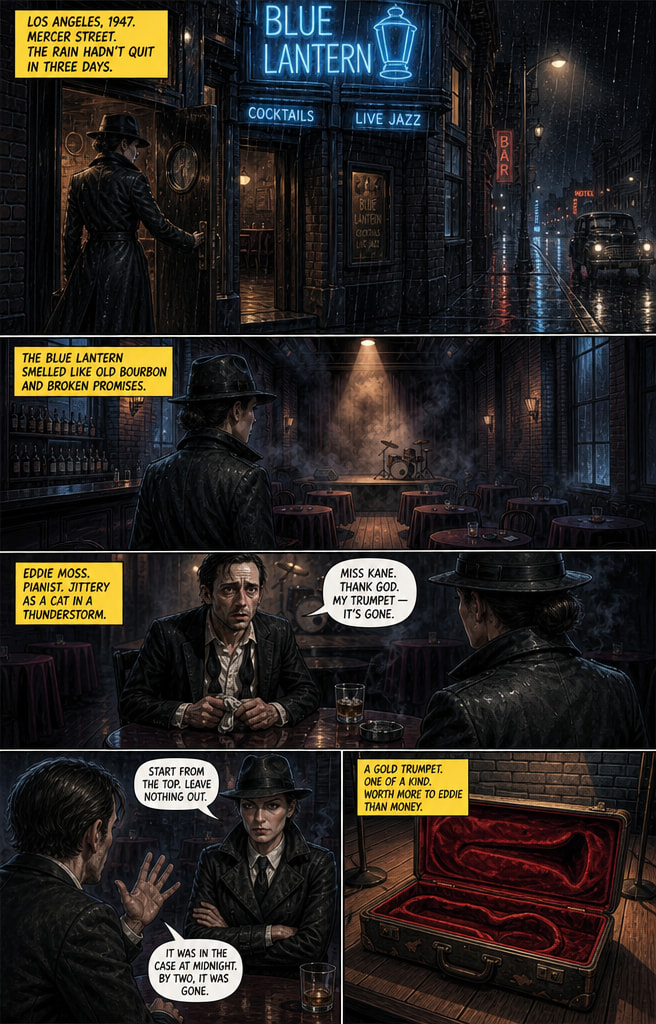
Idea 21 is a real comic: Rain on Mercer Street, a six-page noir made with ComicInk. Page one does the whole setup in four beats: the city, the club, the client, and the empty instrument case that becomes the clue the rest of the story turns on.
Romance comic book ideas
Romance in comics lives in close-ups and silences. Give the couple a reason to keep meeting in the same place.
- Lost luggage. Two strangers keep receiving each other's suitcases on every flight they take.
- The last train. Two night-shift workers share the final train home every night and never speak, until the line closes.
- Letters to the previous tenant. A woman answers the love letters still arriving for whoever lived in her flat before.
- Rival food stalls. Two street vendors at war over the same corner discover they learned to cook from the same grandmother.
- Translation error. An interpreter falls for the person she is paid to translate for, in a language her client doesn't speak.
Slice-of-life comic book ideas
Slice of life stories trade plot for moments. They work beautifully in comics because a quiet panel can hold an emotion a paragraph can't.
- The last bowl. An old ramen chef closing his shop for good cooks one final bowl for a stranger who wanders in at midnight.
- Bus 44. Every chapter follows a different passenger on the same bus route.
- The plant sitter. A teenager waters plants for neighbours on holiday and learns too much about each of them.
- Inherited garden. A woman keeps her late father's allotment alive with the help of the gardeners next door.
- Moving day. A whole friendship told through the six times two friends helped each other move.
Kids and school comic book ideas
For younger readers, give the adventure a clear goal and let the setting do the teaching.
- Shrunk in a leaf. Two kids shrink inside a leaf and get a tour of how plants turn sunlight into food.
- The lighthouse fox. A small fox has to keep the lamp lit on a stormy night while her sleepy friend snores.
- Lunchbox kingdom. The food in a lunchbox holds an election before lunch.
- The homework that bit back. A maths worksheet comes to life and refuses to be finished.
- The class pet's day off. The class hamster has one school day to see the world and be back before the bell.
Historical comic book ideas
History gives you costumes, places and stakes for free. Pick a small, personal story inside a big moment.
- The map maker's daughter. In 1500s Lisbon, a girl corrects her father's maps from the stories sailors tell her.
- The last telegram. A telegraph operator decides whether to deliver a message that will start a war.
- Lighthouse keepers' log. A keeper's diary across forty years of changing ships and coastlines.
- The silent film pianist. A cinema pianist loses her job the night talking pictures arrive.
- Recipe from the ration book. A family tries to recreate a grandmother's wartime recipe from one stained page.
Manga comic book ideas
Manga ideas often run longer and lean on character relationships. Many short manga use a four-part structure called kishōtenketsu: introduction, development, a twist, and the reconciliation that follows. It is a good shape for a one-shot.
- The delivery cyclist. A bike courier in a mountain town races the same rival on every delivery.
- Spirit of the vending machine. A shy student discovers the drink machine at school is haunted, and lonely.
- The calligraphy club. Three students try to save their club by entering a contest none of them can win alone.
- The weather girl. A girl who can make it rain is hired by every sports team in town, for and against.
- Two-person band. A drummer and a singer who can't stand each other share one practice room.
From idea to finished pages: a worked example
To show how a one-line idea becomes a comic, here's what happened to idea 1, the ten-second nurse. It became Night Shift, one of the comics on our homepage.
The logline: an ER nurse who can freeze time for exactly ten seconds, and is wiped out every time she does, uses it during a storm-night pileup.
The cast: three people, kept deliberately small. Priya, the nurse; Dr. Marcus Bell, the gruff senior doctor who covers for her; and Leo, the nine-year-old she saves.
The ending, decided first: dawn on the hospital roof, the whole ER crew sharing coffee. The real superpower is the team.
Page one: no powers yet. It sets the stakes in four beats: the city at 11:47 pm in the storm, the pileup on the highway, the senior doctor ordering every trauma bay opened, and Priya in the middle of the rush.
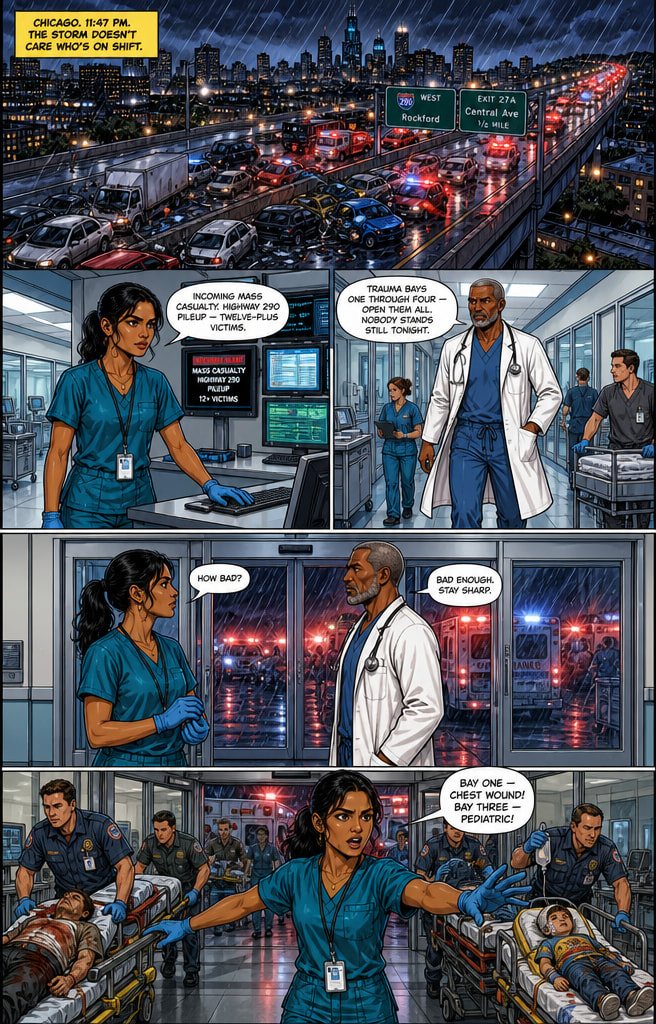
The whole brief for that comic was one paragraph. Everything else (the script, the panels, the dialogue) came from turning that paragraph into pages. That's the point of a strong premise: once you know who wants what, what it costs, and how it ends, the pages mostly write themselves.
Turning your idea into a comic
Once you've picked an idea:
- Write the ending first. One sentence. It stops the middle from wandering.
- Expand it into a short story. If you want help, our free AI story generator writes a short story with named characters from a one-line premise, with no sign-up needed to write it.
- Script it page by page. Our guide to writing a comic book script covers the format.
- Make the pages. How to make a comic book walks through the whole process, and for longer stories see how to make a graphic novel.
If you'd rather not draw, ComicInk turns your premise into finished pages. Sidekick writes the script with you, each character is drawn once and kept consistent on every page, and you choose from 12 art styles, including Manga in our manga maker. An issue can run from 4 to 36 pages, and longer stories can be linked across issues as a story arc. New accounts get 100 free credits with no card, a page costs 50 credits, and your first two renders (a cover or a page) are free. Start from the AI comic generator.
Download the free template
A printable PDF companion to this guide — use it for your next script.
Download a free comic book template (PDF)Ready to make your own comic?
A free account and 100 credits get you started. No drawing skills, no credit card.
Start your comicMore from the blog
How to Make a Comic Book in 2026: A Step-by-Step Guide
From idea to finished pages: free tools, AI generators, script templates, character workflow, and the publishing routes that actually work.
60 Comic Strip Ideas: Easy, Funny & for School
60 comic strip ideas: easy ones for beginners, ideas for school and students, and funny gag strips. Each has a one-click AI version, plus free printable templates.
How to Write a Comic Script: The Complete Guide
Everything that goes into a comic script — format, structure, panel descriptions, dialogue, pacing and a full worked example — with a free downloadable template.